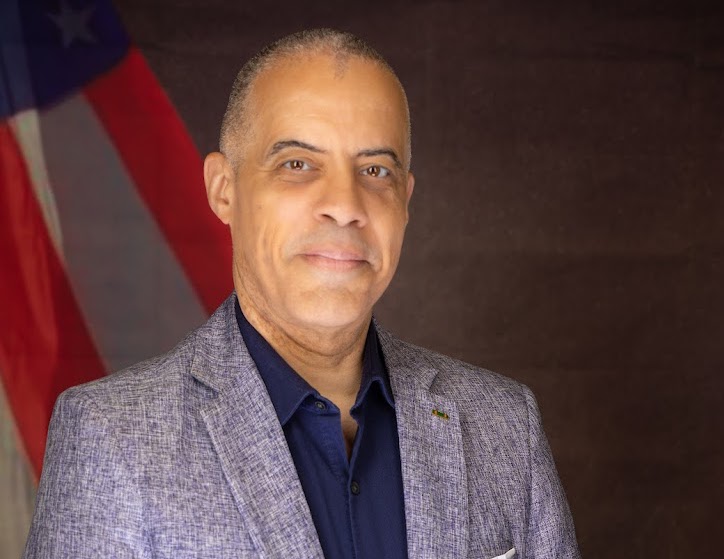
Larry Sharpe begins his argument with a blunt premise: New York’s political system is broken.
For decades, Democrats have governed the state while Republicans have protested from the sidelines. The pattern has become familiar, predictable and, in Sharpe’s view, stagnant. The arguments change. The campaigns repeat. The results remain largely the same.
Sharpe believes voters are tired of it.
His strategy to disrupt that system is unusual even by the standards of outsider politics. Sharpe, a Libertarian, is not simply running as a third-party candidate. Instead, he is attempting to challenge the Republican nominee in the primary, hoping to capture the Republican line for governor while maintaining his libertarian identity.
If it works, the move would scramble the traditional electoral map of New York.
“I am tired of the two-party system just saying the other guy is bad and not fixing anything,” Sharpe said. “I want to fix things.”
Sharpe’s political story begins not in think tanks or party circles but in New York itself.
He was born and raised in New York City before moving to Suffolk County on Long Island for high school. His father worked in law enforcement, first as a police officer and later as a corrections officer at Rikers Island. His mother was an immigrant. His father died when Sharpe was young, and he was raised largely by his mother.
At 17 he joined the Marine Corps. He spent 7 years in the Marines before later working as an English teacher. Over time, he said, he focused on improving his career and building stability in his life.
Eventually he confronted the same question many New Yorkers ask.

Should he leave.
Instead, he decided to stay and run for office.
“I decided instead of leaving, I was going to fix things,” Sharpe said.
He first ran for governor in 2018 and again in 2022. Now he is running again in 2026, convinced that New York’s political culture remains locked in a cycle of accusation rather than reform.
Sharpe’s libertarian identity, he said, emerged gradually.
Early in his life he supported outsider candidates such as Ross Perot and Ralph Nader, despite knowing little about their policy platforms.
“I could not have told you one of Ralph Nader’s policies,” Sharpe said. “I could not have told you one of Ross Perot’s policies. But I voted against the establishment.”
The ideological clarity came later when he heard Libertarian presidential candidate Gary Johnson speak in 2012.
“That is when I said these guys are different,” Sharpe said. “These libertarians are different.”
Today Sharpe’s campaign is built around a larger claim: that neither party has managed to solve New York’s problems.
“For the past 25 years, the Democratic Party has run this state,” he said. “If they were going to fix it, they would have.”
But his criticism does not stop there.
“For the past 25 years, the Republican Party has watched them run it,” Sharpe said. “If they were going to have an idea, they would have.”
Sharpe believes that reality creates an opening for a candidate who can appeal beyond traditional party lines.
His strategy became clearer, he said, when Representative Elise Stefanik stepped aside from the governor’s race.
“With Elise Stefanik dropping out, I recognized that there was no chance of any resistance candidate winning,” Sharpe said.

Sharpe argues that Nassau County Executive Bruce Blakeman, the Republican candidate, cannot build a coalition strong enough to win statewide.
“He does not motivate either side,” Sharpe said. “He is a milquetoast Republican trying to pretend to be conservative.”
In Sharpe’s telling, the electoral math of New York is unforgiving. Roughly 23 percent of voters identify as Republican, about 30 percent are independent or unaffiliated, and 47 percent identify as Democrats.
“Republicans are outgunned 3 to 1,” he said.
Sharpe’s argument is that only a crossover coalition can break that equation. He claims previous campaigns show roughly 30 percent of his support coming from Democrats, 30 percent from independents, and 40 percent from Republicans.
“So, I know I cross over,” he said. “I have the data already.”
Sharpe’s campaign is also built around a criticism of what he calls a culture of resignation inside New York politics.
When selecting his running mate for lieutenant governor, he approached several potential partners before eventually choosing Mike Carbonelli, a law enforcement officer.
Many people declined.
“The reason why they are saying no is if you look at the Republican Party across New York State right now, most of the people who actually want change are quitting,” Sharpe said.
In Sharpe’s view, the deeper surrender may actually lie among those who remain in politics without believing victory is possible.
“The people who are leaving, we think they are quitting,” he said. “The ones quitting are the ones staying because they have given up.”
Carbonelli appealed to Sharpe for both ideological and personal reasons.
“He is more conservative than I am,” Sharpe said. “And I do not mind.”
Sharpe said he intentionally surrounds himself with people who hold different views and who are willing to challenge him directly.
Sharpe says that same openness shapes his campaign events.
“I need people who will tell me no,” he said.
On the trail, he argues, his appearances are different from the traditional fundraising circuit followed by many candidates.

“When people like Blakeman or Hochul say, they are traveling the state, they are not,” Sharpe said. “They are going from fundraiser to fundraiser.”
Sharpe says the audiences he meets are not donors in suits but working people asking direct questions.
“They meet people writing checks,” he said. “I meet people in work boots.”
Sharpe emphasizes what he calls “the full Sharpe,” a practice of traveling to all 62 counties in New York every year.
He says he has done this for 8 consecutive years whether running for office or not.
“I do not only show up when I want your money or votes,” Sharpe said.
Money still matters in a statewide race, but Sharpe argues enthusiasm will matter more than traditional donor networks.
“The problem with Blakeman is he is not exciting,” Sharpe said.
Sharpe maintains a political action committee, though he says its immediate purpose is practical: helping with the petitioning process required to secure ballot access.
If Sharpe were to win the Republican primary, he expects to appear on multiple ballot lines including the Republican, Libertarian and Conservative lines.
To him the ideological boundaries matter less than the possibility of a broader coalition.
“You have to create a coalition,” Sharpe said.
Sharpe points to Donald Trump’s 2024 campaign as an example of how coalitions built across ideological lines can defeat entrenched political systems.
Sharpe’s policy agenda begins with the economy.
His first proposal involves creating a sovereign fund for New York that would eventually pay for education statewide. If that happens, he argues, the state could eliminate school taxes.
“That could cut property taxes by about 50 percent,” Sharpe said.
His second proposal centers on nuclear energy. Sharpe wants nuclear facilities partially owned by local municipalities, allowing communities to share in both energy production and revenue.
His third proposal targets smaller producers.
Sharpe argues that farmers and entrepreneurs who agree to sell only within New York should be exempt from certain federal regulations that favor large national companies.

Immigration is another issue Sharpe addresses with an unconventional approach.
He proposes a privately run vetting system operating alongside the federal immigration process. Migrants could voluntarily undergo screening at dedicated facilities, potentially located in large urban centers.
Those who pass would receive what Sharpe calls an orange card allowing them to work legally for 2 years under strict conditions, including regular check ins and a prohibition on receiving public assistance.
“If you take any public assistance, you get deported,” Sharpe said.
For now, however, the campaign’s immediate focus is less philosophical and more logistical.
Sharpe describes the coming weeks with characteristic brevity.
“Petitions, petitions, travel, petitions.”
The campaign infrastructure is still expanding.
Asked whether he already has teams and offices across the state or is still building them, Sharpe answered simply.
“Both.”
Sharpe’s critique of New York politics returns repeatedly to the same theme.
He argues the Democratic Party has become the party of bad answers while the Republican Party has become the party of no answers.
In that environment, he says, voters often choose the policy that promises immediate relief even if it carries long term consequences.
“We have been given two choices,” Sharpe said. “Zero or free buses.”
The real failure, he argues, is not voters choosing the promise of relief but political leaders failing to offer realistic alternatives.
“You are giving me a history lesson?” Sharpe said, describing how many voters react to ideological arguments. “I cannot pay my rent. My kid cannot read.”
Those concerns, Sharpe believes, define the real terrain of politics in New York.
If he were to win the governorship, he would likely share the stage with New York City mayor Zohran Mamdani, whose progressive agenda represents a sharply different political philosophy.
Sharpe says he knows Mamdani personally.
“He has been on my show,” Sharpe said.
While critical of Mamdani’s economic ideas, Sharpe stops short of personal attacks.
“Mamdani’s ideas are terrible,” he said. “But he is not a bad person.”
Sharpe believes the two might agree on goals while disagreeing fundamentally on how to reach them.
Public transit is one example. Sharpe supports cheaper transit fares but opposes raising taxes to fund them.
Instead he suggests allowing corporations to purchase naming rights to bridges and tunnels.
“MetLife pays 20 million dollars for a stadium,” Sharpe said. “Imagine what a bridge is worth.”
Sharpe argues that multiple such agreements could generate billions for the transit system.
At the center of Sharpe’s campaign is an argument about credibility.
He acknowledges he has never held elected office.
But he says voters already know who he is.
“If there is dirt on me, it already came out,” Sharpe said.
He notes that he has run against Republicans and Democrats in previous elections and has held more than 800 live events across New York State.
“I do a live show every week,” Sharpe said. “If you have a question, call in.”
Whether that openness translates into electoral success remains uncertain.
But Larry Sharpe is convinced that New York voters are ready to challenge the system that has governed them for decades.
And he believes he may be the candidate willing to try.



Be First to Comment