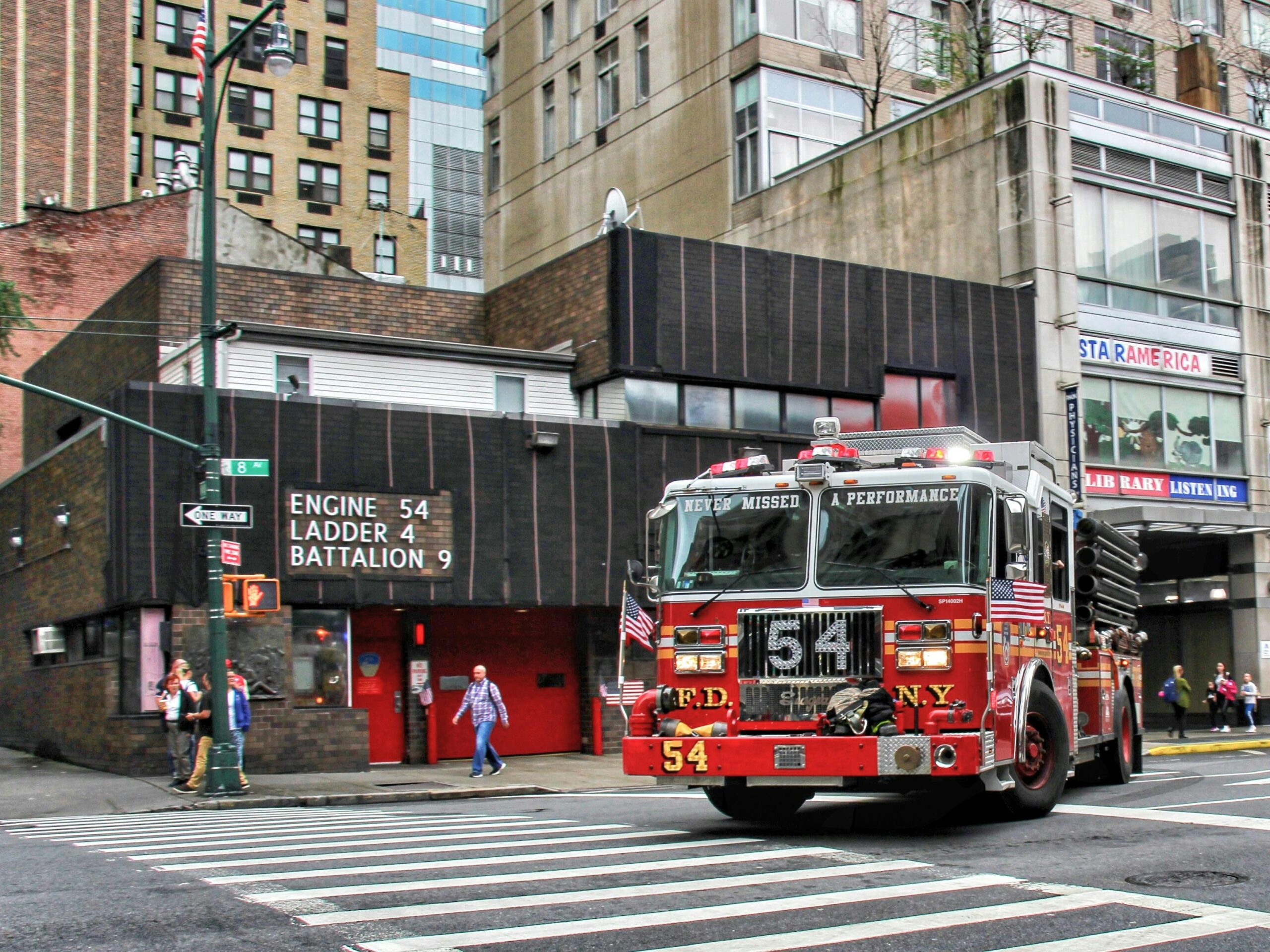
Uneven state economic development and local funding are negatively impacting the New York State Fire Service.
An effective volunteer firefighting movement requires balancing citizen patriotism with county financial resources. New York State is well-off when it comes to patriotism, but very poor when it comes to local finances. In the current situation, volunteer firefighting is ineffective and doomed to extinction. However, this could change if state funding reaches poorer counties and creates at least one paid position in every volunteer fire department.
The Secret of the Fire Service
The key to an effective volunteer fire department is having at least one professional (paid) firefighter. This paid firefighter is typically an Emergency Medical Technician (EMT) or Paramedic. This situation is observed, for example, in Oregon.(1) This is because the fire service primarily provides emergency medical care and only then extinguishes fires. According to official statistics, 75% of calls to the fire department are for emergency medical assistance. And the number of these calls is growing. Nationally, over the past 20 years, the number of calls for emergency medical assistance has increased by 80%, while the number of calls for fires has remained unchanged.(2)
It’s no surprise that the volunteer firefighting movement thrives only in states with strong local economies. A strong local economy provides the foundation for affluent residents who can work as unpaid firefighters without risking starvation. Furthermore, fire departments are traditionally funded by local taxes. Therefore, local taxpayers typically pay for the paid firefighters who work for volunteer fire departments.
Delaware is a shining example of the development of an effective volunteer firefighting movement. This state leads the US in the proportion of fire departments with volunteer firefighters. 98.3% of Delaware’s fire departments are fully or partially composed of volunteers. By comparison, the proportion of such fire departments in New York City is slightly lower, at 95.9%.(3)
However, Delaware is a champion in another little-known metric. This state has the highest proportion of combined fire departments in the United States. That is, fire departments composed of professional (paid) and volunteer firefighters. In Delaware, 55.9% of fire departments have at least one paid firefighter. But in New York, the proportion of mixed fire departments is 10 times lower than in Delaware. But that’s not all. New York is the worst state for the proportion of mixed fire departments in the United States. Only 5.1% of fire departments in New York State have a mix of paid and unpaid firefighters!(3)
Delaware is a state with excellent financial indicators, where many wealthy residents can become volunteer firefighters, and local budgets can afford to pay for a professional firefighter in a predominantly volunteer fire department. Although Delaware’s total GDP in 2024 was a modest $110.972 billion,(4) the state’s three counties demonstrate financial indicators that most counties in New York State can only dream of. In 2024, the GDP of Kent County was $11.652 billion, Sussex County $23.355 billion, and New Castle County $75.963 billion.(5) As we can see, the difference in GDP between counties in Delaware is 7.5 times, and the poorest county has a GDP of $11.652 billion.
What about New York State? Its impressive GDP is $2.468 trillion in 2025.(6) But it’s abject poverty at the level of most counties. In New York State, 45 of 62 counties have a GDP less than the poorest county in Delaware. The GDP of these 45 counties is less than $10 billion per year! Of these 45 counties, 5 have a GDP less than $1 billion.(7) That’s 11 times less than the poorest county in Delaware. A small GDP means poor residents and impoverished local budgets. This explains the decline in the number of volunteer firefighters. It also explains why New York State has such a small proportion of mixed-use fire departments. Most New York counties are too poor to afford even one paid firefighter in each fire department.
Two ways to solve the problem
At first glance, it seems that professional (paid) fire service is doomed in rural New York State. Local residents are so poor that they cannot work for free. And local economies lack the potential to create paid jobs in fire departments. All this is a consequence of errors in long-term planning for the state’s economic development. The state’s economy is so unevenly developed that it cannot support funding for important infrastructure in remote areas. This cannot be achieved through either the volunteerism of wealthy citizens or through tax revenues to local budgets. Meanwhile, New York State’s overall GDP is so enormous that, if it were an independent nation, it would rank 8th in the world!(6)
What are politicians doing in this situation? They’ve decided to shift financial responsibility for fire services to citizens. Politicians have decided to support the volunteer firefighting movement during its decline in New York State. A massive media campaign was conducted, informing voters that the number of volunteer firefighters has declined by 30-40% over 20 years, from 120,000 to 80,000.(8) In response to this challenge, lawmakers in Albany have drafted legislation aimed at supporting volunteer firefighters.(9)
However, as always, there are alternative solutions. Of course, the uneven economic development of New York State cannot be quickly corrected. However, budgetary assistance could provide immediate relief. This refers to changing the principles of funding fire departments in New York State. Paying firefighters from local budgets is not a mandatory rule. In the US, there are states where firefighters and emergency medical services are paid from state budgets. One such state is Hawaii. It has managed to create one of the most professional (paid) fire departments in the US. 91.7% of Hawaii’s fire departments are fully or partially staffed by professional firefighters.(3) Let’s be honest: the Hawaiian government deviated from this rule and in 2021 passed a law funding emergency medical services in Honolulu from local budgets.(10) However, other cities have retained state funding.
Hawaii’s experience could be useful for New York State. Fortunately, New York City’s uneven economic development creates favorable conditions for redistributing tax revenues among counties within the state. Although the state has some poor counties, some boroughs are literally bursting with cash. Manhattan’s GDP is over $100 billion. This is 100 times greater than the GDP of the poorest counties in New York State.(7) And the required financial assistance is not very large.
New York City has 1,649 fire departments (3) serving 1,527 communities. Of these communities, 532 are villages and 933 are small towns.(11) The minimum level of support is to provide all villages with professional (paid) Emergency Medical Technicians (EMTs) or Paramedics who would be part of their local volunteer fire departments. This would create 532 jobs in rural areas, funded by New York State. It would be possible to go a step further and provide jobs in fire departments located in small towns. This would create approximately 900 more jobs. Therefore, the advanced level of support would be 900-1,400 jobs within existing volunteer fire departments.
Hidden reasons determining choice
Of course, political will at the state level is needed to make this decision. So far, legislators are moving in the opposite direction and are trying their best to stop the decline in the number of volunteer firefighters. However, these efforts seem odd. After all, in the US, volunteer firefighters have been replaced by professional (paid) firefighters for over 20 years. That is, the proportion of volunteer firefighters is declining and the proportion of professional firefighters is growing, while the overall number of fire service personnel remains virtually unchanged.
In 1986, there were 1,045,950 firefighters working in the United States. Of these, 237,750 were career and 808,200 were volunteer. In 2023, there were 1,018,100 firefighters working in the United States. Of these, 383,000 were career and 635,100 were volunteer.(12) This means that nationally, career firefighters now make up more than half of the volunteer firefighters. And this figure is constantly increasing.
In New York City, this national trend is not observed. And the proportion of professional firefighters is at a record low. Paid firefighters make up only 20% of the volunteer firefighters.(13) In New York State, the number of volunteer firefighters is declining, but the number of professional firefighters is not increasing. That is, while the fire service in the national format is being transformed from a volunteer to a professional one, in New York State the fire service is simply deteriorating. As noted above, the number of volunteer firefighters has decreased by almost 40,000 people over 20 years. However, the number of professional firefighters has not increased during this time. There is evidence that in 2026, approximately 18,000 people were professional firefighters in New York State.(14) This is almost the same as in 2017.(15)
The only logical explanation for New York politicians’ reluctance to follow the national trend and transform the volunteer fire service into a professional one is to save money for wealthy counties that could come to the aid of their poor neighbors. It’s hard to imagine that New York politicians aren’t aware of the Hawaii experience. When politicians tell voters that there’s no financial capacity to fund a rural fire department, it’s sheer deceit. The reason for this deceit is that the current generation of politicians relies on voters who are uninvolved (low-informed) in current events. This is discussed in detail in my article “Donald Trump’s Most Thankless and Dangerous Job.”(16)
The result is an unfair situation where the poor continue to help the rich. Volunteer firefighters are mostly residents of poor counties, where most volunteer fire departments are located. Meanwhile, professional fire departments are primarily located in New York City and other large cities with larger budgets. Residents of poor counties, by participating in volunteer fire departments, save the state budget, or rather the budgets of wealthy boroughs, $3.8 billion(17) annually!
Conclusion
The reduction in volunteer firefighters is a clear signal that rural residents can no longer support the state’s infrastructure with their unpaid labor. And the actions of politicians are a clear signal that they want to force residents to continue doing so. Time will tell who wins this debate.
References
1. https://www.corvallisoregon.gov/fire/page/about-your-fire-department
2. https://www.nfpa.org/news-blogs-and-articles/nfpa-journal/2026/02/11/volunteer-fire-service-crisis
3. https://apps.usfa.fema.gov/registry/summary
4. https://en.wikipedia.org/wiki/List_of_U.S._states_and_territories_by_GDP
5. https://fred.stlouisfed.org/release/tables?rid=397&eid=1056185#snid=1056187
6. https://en.wikipedia.org/wiki/Economy_of_New_York_(state)
7. https://en.wikipedia.org/wiki/File:New_York_(state)_counties_by_GDP_(2021).png
8. https://www.cbsnews.com/newyork/news/long-island-volunteer-firefighter-recruitment-drive/
9. https://www.nysenate.gov/legislation/bills/2025/A10591
11. https://en.wikipedia.org/wiki/List_of_municipalities_in_New_York
13. https://www.osc.ny.gov/files/local-government/publications/pdf/fireprotection0317.pdf
15. https://www.osc.ny.gov/files/local-government/publications/pdf/fireprotection0317.pdf
16. https://thebigapplegazette.com/donald-trumps-most-thankless-and-dangerous-job/
17. https://fasny.com/wp-content/uploads/2023/03/FASNY-Economic-Study-2023.pdf




Be First to Comment