Have you ever wondered how New York City became known around the world as “The Big Apple”? Say those three words anywhere, from a busy boulevard in Los Angeles to a quiet cafe in Italy, and people immediately picture our skyline, our grit, and our dreams. This December 1st marks a remarkable milestone: the 100th anniversary of the landmark 1926 newspaper column that revealed the true origin of New York’s most beloved nickname. Yet for decades, the real story behind those three words was buried beneath myth and guesswork, and the people who gave them to us have gone largely unrecognized.
Before the early 1990s, theories floated everywhere. Some claimed the phrase came from a 19th-century boardinghouse madam, while others guessed it started with Depression-era street vendors selling apples on Manhattan corners. It took two dedicated etymologists working on their own time and out of sheer respect for the truth to finally solve the mystery: Dr. Gerald Cohen, a professor at Missouri University of Science and Technology, and Barry Popik, a New York City researcher and former administrative law judge. Searching through dusty archives and fragile reels of microfilm in the early 1990s, they uncovered a story far richer, more diverse, and more deeply human than any urban legend.
Although an early literary reference appeared in Edward S. Martin’s 1909 book The Wayfarer in New York, the nickname that captured the world’s imagination was born on the dirt tracks of the American racing circuit in the 1920s. In January 1920, a sportswriter for the New York Morning Telegraph named John J. Fitz Gerald was in Louisiana covering winter racing at the New Orleans Fair Grounds. Outside the barns, he overheard two Black stablehands talking with unmistakable excitement about heading north for the New York racing season. To them, New York was not just another stop on the map. It was “the Big Apple.” In thoroughbred racing, an apple was the sweetest treat a horse could earn, and New York’s premier tracks were the grandest prize any jockey, trainer, or stablehand could hope to reach.
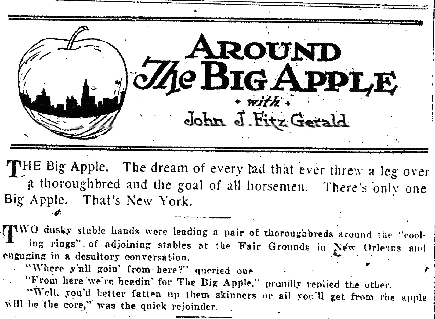
Fitz Gerald never forgot what he heard. He first put the phrase into print in May 1921, and on February 18, 1924, he gave the nickname national visibility by launching a recurring column titled “Around the Big Apple.” He wrote a line that still rings true a century later: “The Big Apple. The dream of every lad that ever threw a leg over a thoroughbred and the goal of all horsemen. There’s only one Big Apple. That’s New York.” Then, on December 1, 1926, filing a column from New Orleans, Fitz Gerald answered the flood of readers asking where the phrase came from and gave honest, lasting credit to the stablehands whose conversation started it all. As we approach the 100th anniversary of that December 1st column, his words remind us just how deeply working people shaped the identity of New York City.
From the racetracks, the nickname moved straight into the heartbeat of New York culture, carried forward at pivotal moments by people who believed in what this city stood for.
From Harlem’s Jazz Age to a City’s Comeback
In the 1930s, Black jazz musicians in Harlem embraced “The Big Apple” as a badge of honor. Playing in the world’s greatest jazz capital meant you had made it to the top. As the old musicians’ saying went, “There are many apples on the tree, but when you pick New York City, you pick the Big Apple.” In 1934, the Big Apple Bar & Grill opened at West 135th Street and Seventh Avenue (now Adam Clayton Powell Jr. Boulevard) in Harlem, becoming a lively neighborhood landmark. By 1937, a joyous swing dance called “The Big Apple” swept from the South into Harlem’s Savoy Ballroom and across the country, while syndicated New York columnists like Walter Winchell kept the phrase alive in newspapers coast to coast.
By the late 1960s, however, the slogan had faded from everyday conversation, and New York City was entering one of the most difficult chapters in its modern history. Then came 1971, when proud New Yorkers brought the Big Apple roaring back. Gwen Barrett, a young Black community affairs director at WNEW-TV (Channel 5) who went on to become a three-time Emmy Award-winning producer and vice president at the station, conceived a “Big Apple” public service campaign to lift the city’s image, even receiving permission from Duke Ellington to use his “Big Apple” music. Around that same time, Charles Gillett, president of the New York Convention and Visitors Bureau, embraced the nickname and rolled out the now-iconic red apple tourism campaign, handing out lapel pins to remind the world of New York’s warmth and resilience.
A Legacy Left Behind
For all the pride, tourism revenue, and global goodwill “The Big Apple” has brought New York over the past century, the people who gave it to us have been largely overlooked.
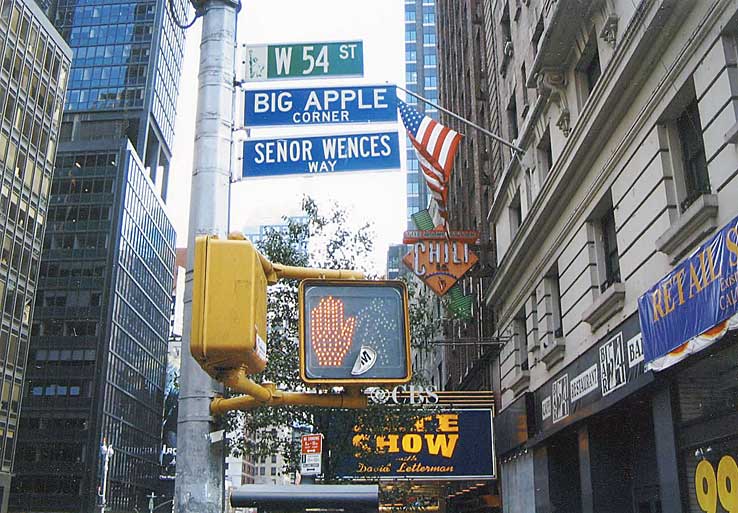
John J. Fitz Gerald, the newspaperman who listened with respect to two working stablehands and shared their words with the world, passed away in 1963 during the historic New York City newspaper strike. Because the city’s major newspapers were shut down, no obituary marked his passing in the papers he had served his entire career. Today, he rests in an unmarked grave at St. Agnes Cemetery in Menands, New York. Aside from a single street sign at West 54th Street and Broadway, designated “Big Apple Corner” in 1997 by Mayor Rudy Giuliani after years of tireless advocacy by Barry Popik, there is almost no permanent public tribute to Fitz Gerald, the New Orleans stablehands, Harlem’s Big Apple legacy, or Gwen Barrett.
During our research for this feature, The Big Apple Gazette reached out to Mr. Barry Popik to ask why, after more than three decades, he still works so hard to keep this history alive and push for these unsung figures to receive their due. His answer was simple, humble, and straight from the heart:
“It’s the right thing to do.”
That single sentence says everything. History is not only made by mayors, tycoons, and monuments. It is made by stablehands dreaming big outside a New Orleans barn, a sportswriter willing to give them credit, Harlem artists who turned a phrase into music, broadcasters who lifted up a struggling city, and researchers who refuse to let their contributions fade away.
Why This Mission Is Personal to Us
For everyone at The Big Apple Gazette, this history hits close to home. Our very name and our logo, which proudly combines the New York City skyline with the Big Apple slogan, are directly shaped by this story. Every edition we publish carries the spirit of the people who gave those three words meaning. Recognizing their legacy as the December centennial arrives is not just good journalism to us; it is a way of honoring the foundation our publication stands on.
The Big Apple Gazette’s 11-Point Campaign for Recognition
With the 100th anniversary arriving this December, The Big Apple Gazette is launching a campaign to make sure the heroes behind “The Big Apple” finally receive the recognition they deserve. We have ordered our eleven goals starting with the actions most directly within New York City’s power and moving outward to city-backed institutions, private partners, New York State landmarks, and out-of-state tributes:
1. Formally Honor Gwen Barrett: Urge the New York City Council and the Mayor’s office to issue an official proclamation honoring Gwen Barrett for her pivotal 1971 work at WNEW-TV (Channel 5) that helped bring “The Big Apple” back into the city’s spotlight.
2. Dedicate “Big Apple Place” in Harlem: Ask the City Council to co-name the corner of West 135th Street and Adam Clayton Powell Jr. Boulevard (Seventh Avenue) as “Big Apple Place” in honor of the 1934 Big Apple Bar & Grill. Because a Popeyes restaurant now occupies that exact historic corner, we also plan to contact Popeyes to join local leaders in celebrating and recognizing the site’s Harlem heritage.
3. Complete “Big Apple Corner”: Work with the City Council and the NYC Department of Transportation to add an apple emblem to the existing “Big Apple Corner” street sign at West 54th Street and Broadway so every New Yorker and visitor who passes by immediately sees its meaning.
4. Teach “Big Apple” History in NYC Public Schools: Advocate for NYC Public Schools to teach “Big Apple” and New York City history in classrooms, especially every February 18 during Black History Month, and partner with a comics group to create a “Big Apple” comic book that can be shared with students or sold to tourists.
5. Create a Permanent Exhibit at the Museum of the City of New York: Urge the Museum of the City of New York, a premier cultural institution housed in a City-owned building, to display Fitz Gerald’s 1924 and 1926 “Big Apple” columns or establish a permanent “Big Apple” display.
6. Publish an “Overlooked” Obituary in The New York Times: Submit a formal public campaign asking The New York Times to feature John J. Fitz Gerald in its renowned “Overlooked” obituary series, filling the historical gap left by the 1963 New York City newspaper strike.
7. Preserve the Archives Through Philanthropy: Contact Stephen A. Schwarzman, the major benefactor behind the New York Public Library’s flagship building, to help fund the digitization of the New York Morning Telegraph so this irreplaceable record of New York journalism is preserved and accessible forever.
8. Bring the Story Back to Belmont Park: Contact the New York Racing Association and Belmont Park, located just across the Queens border in Nassau County, to install a “Big Apple” plaque, sculpture, or permanent tribute honoring the racing heritage that gave New York its name.
9. Mark John J. Fitz Gerald’s Resting Place: Work with cemetery officials and community donors to place a proper gravestone for John J. Fitz Gerald at St. Agnes Cemetery in Menands, New York, so the newspaperman who chronicled the Big Apple is never forgotten again.
10. Exhibit the Columns in Saratoga Springs: Urge the National Museum of Racing and Hall of Fame in Saratoga Springs to put Fitz Gerald’s landmark 1924 and 1926 “Big Apple” columns on public display.
11. Recognize the Originators in Louisiana: Contact the New Orleans Fair Grounds to establish a lasting tribute honoring the Black stablehands whose words started it all more than a century ago.
How You Can Be Part of History
A nickname that belongs to all of New York deserves an effort powered by New Yorkers. Below is our Change.org petition, which we will submit alongside a formal resolution to the New York City Council urging our elected leaders to take action on the honors within the city’s reach and lend New York’s voice to the rest:
- Sign and Share the Petition: Sign the Big Apple 100th Anniversary Petition on Change.org
With the 100th anniversary arriving right around the corner on December 1st, we may not be able to finish every single tribute on the exact anniversary day itself, but our commitment is clear: we are going to make sure these honors happen during this centennial season. For readers, neighbors, and proud New Yorkers who would like to help fund a commemorative plaque, gravestone, or tribute presentation, donations can be made through our parent organization, Devil Dog USA Incorporated, which supports community initiatives and civic projects right here in New York City:
- Support the Tribute Fund: Donate Through Devil Dog USA Incorporated
For a hundred years, “The Big Apple” has stood for hope, ambition, and the promise that anyone, no matter where they start, can reach for the sweetest prize on the tree. As December brings this centennial moment to our doorstep, it is our turn to give something back to the people who planted those seeds. Because, as Barry Popik reminded us, it is simply the right thing to do.


Be First to Comment