Made by a family of Italian sculptors in the late nineteenth century, an everyday object has entered the Metropolitan Museum of Art’s collection. The story of the Piccirilli brothers tells of work, integration, and the cultural legacy they left to the city that welcomed them.
The Piccirilli Brothers’ fireplace entered the collection of New York’s Metropolitan Museum of Art in 2025, more than 130 years after it was made in the Bronx. It came neither from a wealthy collector’s residence nor from a public building. It belonged to the workshop of the Piccirilli Brothers, six Italian craftsmen who helped create some of America’s best-known monuments. Unlike their monumental works, the fireplace was intended for everyday life. Its place in the museum’s collection now offers a way to tell a less familiar story: that of the people and relationships behind American sculpture.
The fireplace surround and insert, dating to around 1893, stood in a private ground-floor room within the Piccirilli complex on East 142nd Street in Mott Haven. According to the Metropolitan Museum, family members, studio assistants, and friends gathered there to share meals and spend time together. The fireplace belonged to a setting where work and private life met.
Nearly five feet tall, the fireplace is made of marble with brass, copper, and iron elements. Two partly draped cherubs support a frieze decorated with birds and flowers. At the center is a cartouche bearing the initials PB, for Piccirilli Brothers. The museum credits the brothers with collaborating on its design and production. We do not know what each contributed, but the shared signature captures the character of their family enterprise.
The story began far from the Bronx, in Massa, Tuscany, Italy, near the famous marble quarries of Carrara. Their father, Giuseppe Piccirilli, had taught his six sons the craft. In 1888, the family arrived in New York with skills rooted in Italy’s sculptural tradition. The city was expanding, putting up public buildings and commissioning monuments. It needed craftsmen capable of turning sculptors’ designs into works in stone.
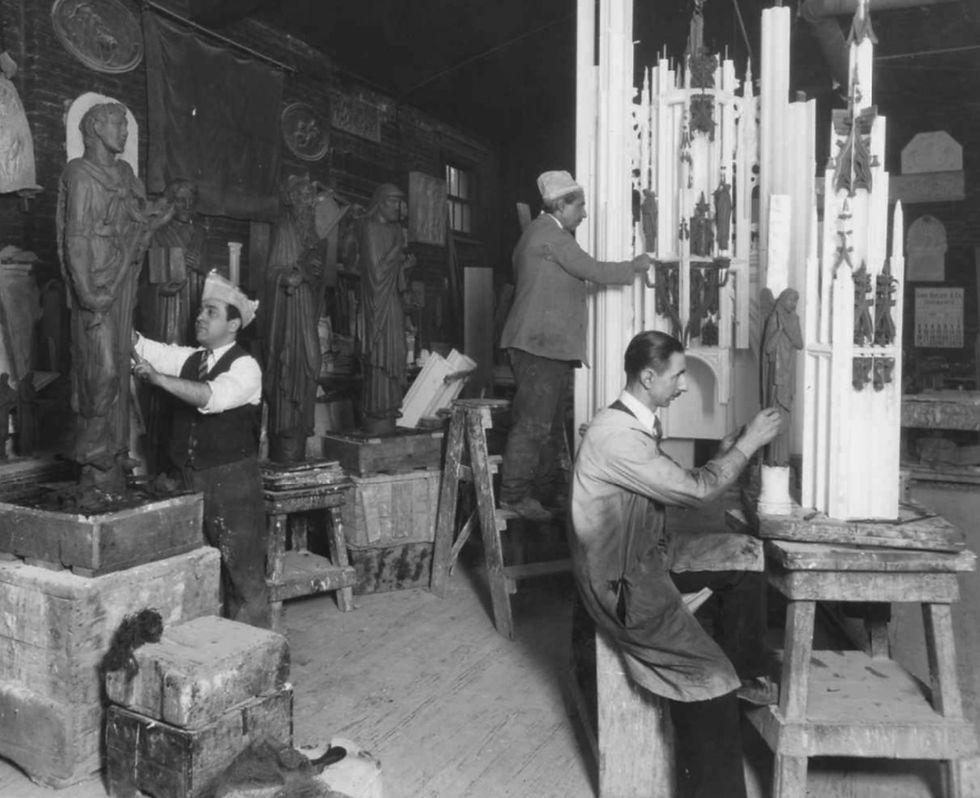
The brothers gradually established their business within an artistic world in which designing and carving demanded different skills. Much of their expertise lay in translating models made by other artists into monumental sculptures while preserving their forms and proportions. Such work required precision, experience, artistic judgment, and close cooperation with the artists responsible for the designs.
Their best-known achievement is the seated Abraham Lincoln at the Lincoln Memorial in Washington, D.C. American sculptor Daniel Chester French designed the statue and entrusted the marble carving to the brothers. In their Bronx workshop, 28 blocks of Georgia marble were carved into sections that would fit together with almost invisible seams. The finished statue became one of the United States’ national symbols. An essential part of its physical creation had taken place in a Bronx workshop.
A few years earlier, in 1911, the brothers had carved the two pink Tennessee marble lions outside the New York Public Library, following a design by Edward Clark Potter. Later known as Patience and Fortitude, they became familiar landmarks to generations of New Yorkers. The brothers’ contribution was not limited to carving other artists’ designs: several, particularly Attilio, pursued artistic work of their own.
A family from Italy had found a place in American society where they could practice and develop their skills. Through their work, they also helped shape that society’s visual identity. Monuments encountered by residents outside libraries and public buildings were, in part, the product of skills brought across the Atlantic.
The fireplace tells the other side of the story. It was not commissioned to honor a president or embody a national ideal. It served a room used by the people who lived and worked at the studio. Yet its carved details display an artistic care that goes beyond practical necessity. Classical figures, decorative motifs, and the family monogram turn a domestic architectural feature into evidence of its makers’ professional culture.
How does an object like this find a place in a museum alongside works originally created to be admired? An artifact can serve a practical purpose while also carrying aesthetic value and historical meaning. In this fireplace, those qualities cannot be separated. Its significance rests not only on the craftsmanship of its decoration but also on its origins and its connection to a workshop where nationally important sculptures were made.
Entering a museum collection does not necessarily create an object’s artistic value. It does, however, change its context. Something once part of a private space can be preserved, studied, and understood as evidence of a much broader historical experience.
The studio closed in 1946, after decades of production. The complex on East 142nd Street was later demolished. Records and photographs survive, including materials held by the New York Public Library: images of sculptors at work, models, and sculptures in progress. They document a working environment that can no longer be seen in its original form.
The fireplace followed a different path. It survived the disappearance of the workshop and was donated to the Metropolitan Museum in 2025 by Joel Rosenkranz. This was not the first recognition of the Piccirilli Brothers’ importance; their contributions had already been documented. But it brought into the museum’s collection an object directly connected to their everyday lives. The fireplace is not currently on public display.
Preserving it allows us to see the Piccirilli Brothers from a perspective different from that offered by their great monuments. They were not simply craftsmen entrusted with prestigious commissions, but a family who built a place for work, relationships, and everyday life in the Bronx. The library lions and Lincoln’s statue now belong to America’s cultural landscape. The fireplace preserves something of the world from which those works emerged: a family who brought their skills to America and, through their labor, contributed to the cultural heritage of the community that welcomed them.
Photo: Inside one of the Piccirilli Brothers’ sculpture studios in the Bronx, where Italian immigrant craftsmen transformed marble into monumental works of American art. The photograph was published in 1919.



Be First to Comment